
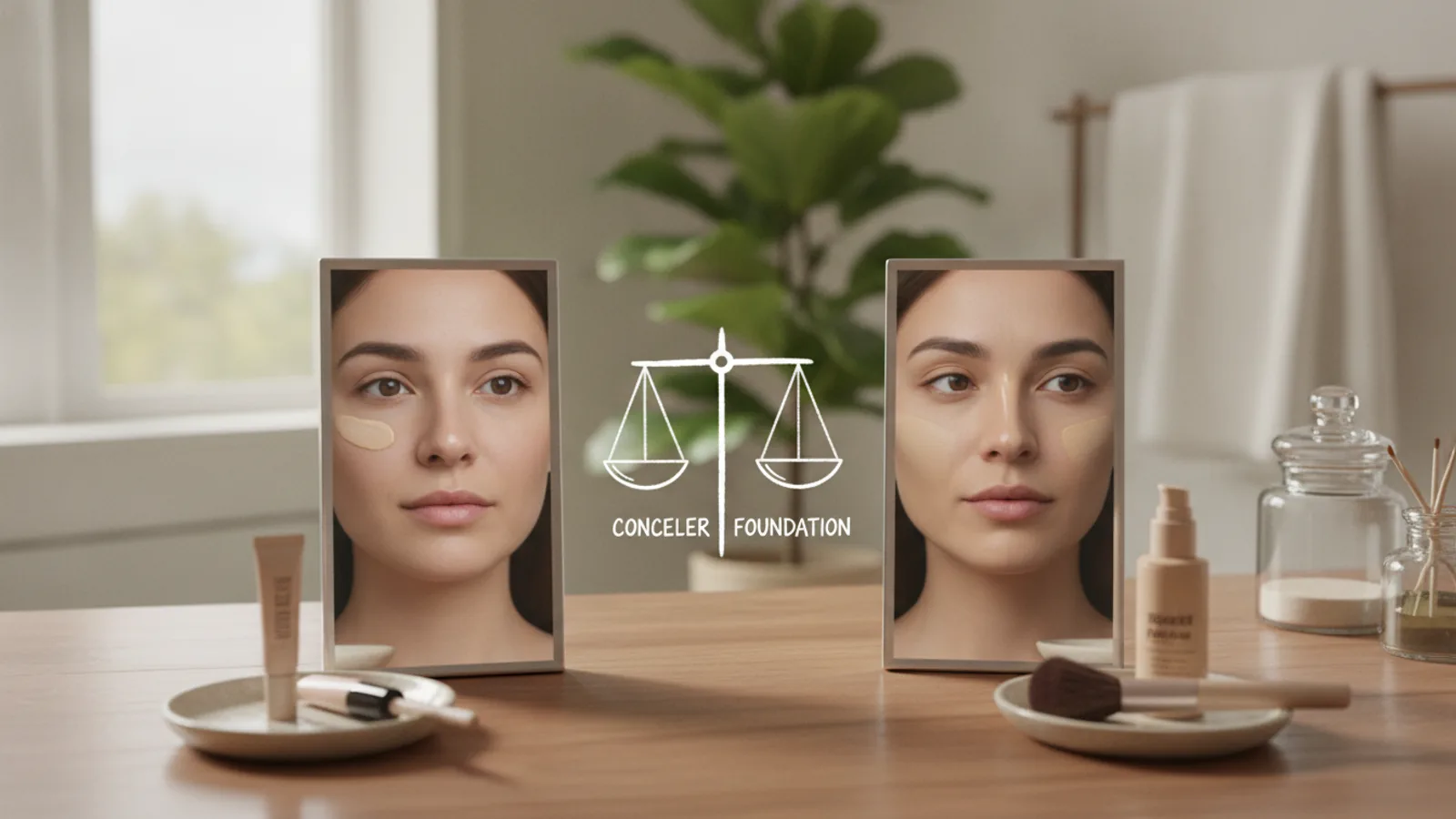
Concealer vs Foundation: Which Should You Choose?
Head-to-head comparison
Overall winner: Concealer for its versatility and mindful application.
For most daily routines, concealer offers a gentle, targeted approach that enhances your skin rather than masking it. It’s the perfect tool for a "less is more" philosophy. Foundation remains the best choice for those who desire a uniform, all-over canvas for special events or as a personal preference for a more polished look.
Option A
Concealer
- Best for targeted corrections
- High-pigment, precise application
- Can feel heavy if used broadly
Option B
Foundation
- Best for an even, all-over base
- Creates a uniform skin tone
- Requires more blending and time
Head-to-Head Scorecard
Navigating the world of makeup can sometimes feel overwhelming, especially when faced with two products that seem so similar. Concealer and foundation are cornerstones of many personal care routines, yet they serve distinct purposes. Choosing the right one for your needs isn't about which is definitively "better," but about which aligns with your lifestyle, skin goals, and the amount of time you wish to dedicate to your morning ritual.
This guide offers a calm, practical comparison of concealer vs foundation. We’ll explore their core differences, how they fit into a mindful routine, and which one might be the gentle, effective solution you’re looking for. Our analysis is based on extensive product research, understanding of cosmetic formulations, and common user experiences, designed to help you make a thoughtful choice without the pressure of trends.
Concealer vs Foundation: Key Differences
At first glance, concealer and foundation appear to be variations of the same thing: a skin-toned cosmetic designed to improve the appearance of your complexion. While this is true, their formulation, intended use, and application method create a clear distinction. Understanding these differences is the first step toward building a routine that feels effortless and authentic to you.
Think of it like this: foundation is the canvas, while concealer is the fine-detail brush.
- Pigment Concentration: The most significant difference lies in the formula. Concealer is much more pigmented than foundation. It’s designed to provide opaque coverage over a very small area—a blemish, a dark spot, or under-eye circles. Foundation has a lower concentration of pigment, designed to be spread thinly over the entire face to even out skin tone without looking like a mask.
- Texture and Consistency: Because of its high pigment load, concealer is typically thicker and creamier. This helps it adhere to specific spots without migrating. Foundation is more liquid or fluid, which allows it to be blended seamlessly across large areas like the cheeks, forehead, and chin.
- Intended Use: Foundation's job is to create a uniform base, reducing overall redness and creating a consistent color palette for any other makeup you might apply. Concealer’s job is to correct, hide, or "conceal" specific imperfections that might still be visible after foundation, or to be used alone for targeted touch-ups.
- Shade Matching: Generally, you want your foundation to be an exact match to your skin tone to avoid a visible line at your jaw. With concealer, you might use multiple shades. A concealer for blemishes should match your skin (and foundation) perfectly, while a concealer for brightening under the eyes is often chosen in a shade slightly lighter than your skin tone.
Measurement
Routine Fit
How a product integrates into your daily life is just as important as how it performs. A mindful routine should feel supportive, not stressful. When comparing concealer vs foundation on this metric, we consider speed, adaptability, and the overall feeling they contribute to your morning.
Foundation application is a more deliberate process. To achieve a natural, seamless finish, it requires careful blending with a brush, sponge, or fingertips. It’s a distinct step that says, "I am applying makeup today." This can be a beautiful, meditative ritual for those who enjoy the process. However, on busy mornings or days when you crave simplicity, a full foundation routine can feel like a chore. It often requires more prep (primer) and setting (powder) to ensure it wears well throughout the day.
Concealer, by contrast, offers unparalleled flexibility. It’s the champion of the five-minute face. You can dab a small amount under your eyes, around your nose, and on any small spots of concern, blend the edges with your ring finger, and be ready to go. It works beautifully on its own for a "your skin but better" look. This adaptability makes it a perfect fit for a minimalist approach, for travel, or for days when you just want to look a little more rested without committing to a full face of makeup.
Measurement
Coverage & Finish
The primary function of both products is coverage, but they deliver it in fundamentally different ways. This category isn’t about which provides "more" coverage, but about the quality and type of coverage each is designed to achieve.
Foundation excels at providing sheer-to-medium, buildable coverage over the entire face. Its purpose is to even things out on a macro level—reducing the appearance of widespread redness, subtle sun damage, or an uneven skin tone. Foundations come in a vast array of finishes, from dewy and luminous to satin and matte, allowing you to control the overall texture and glow of your complexion. A good foundation creates a flawless-looking canvas that appears uniform and smooth.
Concealer provides highly concentrated, often full coverage for small, specific areas. It’s a specialist tool. Its thick, pigmented formula is engineered to completely obscure the color of what’s underneath it, whether that’s the deep purple of a dark circle or the angry red of a blemish. While some lighter-weight concealers exist for under the eyes, their core strength is opacity. Using a concealer all over the face would look heavy, cakey, and unnatural because it isn't designed to be spread thinly.
Neither product can be judged superior here because they aren't competing for the same job. Foundation provides the even base, and concealer provides the targeted fix. They are designed to work in harmony, or in the case of a minimalist routine, concealer can stand alone for precision tasks. It's a matter of the right tool for the right purpose.
Measurement
Ease of Use
For a product to become a staple in a calm, efficient routine, it needs to be straightforward to apply. Here, we look at the learning curve, the tools required, and the margin for error for both concealer and foundation.
Concealer is arguably one of the most intuitive makeup products. Most formulas, whether in a tube, pot, or wand, are easily applied with a fingertip. The warmth of your skin helps the product melt and blend seamlessly. The application is direct and simple: see a spot, tap on some product, and gently blend the edges. While brushes and sponges can be used for a more airbrushed finish, they are not essential for a beautiful result. The small area of application also means that mistakes are minor and easy to correct.
Foundation requires more skill and, often, more tools. Achieving a streak-free, natural finish can take practice. Brushes can leave streaks if not used correctly, sponges can soak up a lot of product, and applying with fingers can sometimes look uneven. Getting the right amount of product is also a challenge; too much can look heavy, while too little won't provide the desired coverage. Blending along the hairline, jawline, and around the nose requires attention to detail to avoid a mask-like effect. It's a skill that can certainly be mastered, but it presents a higher barrier to entry for a beginner or someone seeking simplicity.
Measurement
Value
Mindful consumption involves considering not just the initial price but the long-term value of a product. This includes how long it lasts and how much you need to use to achieve the desired effect. In the concealer vs foundation debate, the cost-per-use tells a clear story.
A standard bottle of foundation typically contains about 1 fluid ounce (30 ml). If used daily, applying one pump to cover the entire face, a bottle might last for several months. However, because it covers such a large surface area, it's consumed relatively quickly compared to its counterpart.
Concealers come in much smaller packages, often between 0.15 and 0.3 fluid ounces (5-10 ml). While the price per ounce might seem higher, the amount of product needed per application is minuscule. A few tiny dots are usually sufficient to cover under-eye circles and a blemish or two. Because you use so little, a single tube of concealer can easily last for a year or even longer, even with regular use. This makes the long-term cost of using concealer significantly lower than that of foundation.
Furthermore, because concealer is so versatile (a point we'll cover next), its value is compounded. A single product can serve multiple functions, reducing the need to purchase other items and simplifying your collection.
Measurement
Versatility
A truly useful product is one that can adapt to different needs. Versatility simplifies your routine, your travel bag, and your budget. When we compare these two complexion staples, one clearly stands out as a multi-purpose powerhouse.
Foundation has one primary job: to create an even base. While you can find formulas with added skincare benefits like SPF or hydration, its function within a makeup routine is singular. You can sheer it out with moisturizer to create a tinted moisturizer, but you can't really build it up to effectively hide a dark blemish without it looking cakey. Its purpose is well-defined and, consequently, limited.
Concealer, on the other hand, is a true multitasker. Its core function is to conceal, but its uses extend far beyond that. A shade slightly lighter than your skin tone can be used to brighten and highlight the high points of your face, like the brow bone and bridge of the nose. It can act as a perfect eyeshadow primer, evening out the color of your eyelids and giving shadows something to grip onto. It can even be used to clean up the edges of a bold lipstick or winged eyeliner for a sharp, precise finish. This adaptability makes it an incredibly valuable tool in any makeup kit, especially for those who appreciate minimalism and efficiency.
Choose Concealer If...
- You prefer a natural, "no-makeup" makeup look. A few well-placed dabs of concealer can make you look refreshed and awake without the feel of a full face of product.
- Your routine is minimalist and time-sensitive. Concealer is the fastest way to address specific concerns and even out your complexion in just a minute or two.
- Your primary concerns are specific spots. If you're mainly looking to cover blemishes, dark circles, or redness around the nose, concealer is the precise tool for the job.
- You value multi-purpose products. You want one product that can cover, highlight, and prime, reducing clutter and simplifying your routine.
- You have generally clear skin. If you don't need to alter your overall skin tone, there's no need for an all-over product like foundation.
Choose Foundation If...
- You want to create a perfectly even, uniform skin tone. If you have widespread redness, discoloration, or just prefer a smooth canvas, foundation is designed for this.
- You enjoy the ritual of applying makeup. For many, the process of blending foundation is a calming, creative practice.
- You are wearing a full makeup look for an event or photos. Foundation provides a reliable, long-wearing base that helps other products like blush and bronzer apply smoothly and last longer.
- You prefer a more polished, "done" look. Foundation provides a level of finish and completeness that concealer alone typically cannot achieve.
- You need to cover a larger area of concern. For skin conditions like rosacea or widespread acne scarring, foundation provides more practical and effective coverage.
Final Verdict: Concealer vs Foundation
After a careful comparison, concealer emerges as the winner for its superior versatility, ease of use, and alignment with a modern, mindful approach to personal care. It empowers you to work with your skin, not against it, by offering precise solutions exactly where you need them. Its ability to fit into the quickest of morning routines while also serving multiple functions makes it an invaluable, high-value tool for nearly everyone.
This does not mean foundation is obsolete. It remains an excellent and necessary product for those who seek the polished, even finish it provides. For special occasions, professional settings, or simply as a matter of personal preference, foundation delivers a reliable and beautiful result. The choice is not about abandoning one for the other, but about thoughtfully selecting the right tool for your specific needs and lifestyle.
For a gentle, everyday routine that celebrates your natural skin, starting with a good concealer is the most practical and empowering choice. It allows you to feel confident and put-together with minimal product and minimal effort, embodying the calm and intentional spirit of a well-curated life.
Concealer vs Foundation: Which Should You Choose? FAQ
Can I use concealer as a foundation?
While you technically can, it's generally not recommended for all-over use. Concealer is much thicker and more pigmented than foundation. Applying it to your entire face would likely feel heavy, look cakey, and be difficult to blend naturally. It can also be more expensive to use in such large quantities. However, you can mix a small amount of liquid concealer with a moisturizer to create a sheer, customized tinted moisturizer for a light-coverage day.
Which should I apply first, concealer or foundation?
Most makeup artists recommend applying foundation first. Foundation will even out your skin tone and cover minor imperfections, meaning you'll need to use much less concealer afterward. Applying foundation over concealer can cause the concealer to smudge or wipe away. The exception is color-correcting concealers (like green for redness or peach for dark circles), which should be applied before foundation and blended carefully.
Do I need to own both concealer and foundation?
Not at all. The goal is to build a routine that serves you. If you have relatively even skin and only want to cover minor spots or dark circles, a concealer is likely all you need. If you prefer an all-over polished look and find your foundation provides enough coverage, you might be able to skip concealer. Many people find having both offers the most flexibility—foundation for events or "full makeup" days, and concealer for quick, everyday touch-ups.
How do I choose the right shades?
For foundation, the goal is an exact match to your skin tone. Test shades on your jawline in natural light to find one that disappears into your skin. For concealer, it depends on the use. To cover blemishes, choose a shade that perfectly matches your foundation. To brighten the under-eye area, select a shade that is one to two shades lighter than your skin tone with a complementary undertone (e.g., a peach-toned concealer can help neutralize blue/purple circles).
Are there natural or "clean" options available for both?
Yes, absolutely. The demand for gentle, mindfully formulated cosmetics has led to a wonderful expansion in the "clean beauty" space. Many brands now offer both concealers and foundations made without common irritants like synthetic fragrances, parabens, and phthalates. They often feature skin-soothing ingredients like aloe, jojoba oil, and mineral pigments, making them excellent choices for those with sensitive skin or who prefer a more natural approach to their personal care products.